Showing posts with label Tales of Abu Nuwas. Show all posts

Sunday, April 14, 2024

Two NEW Large Print Books

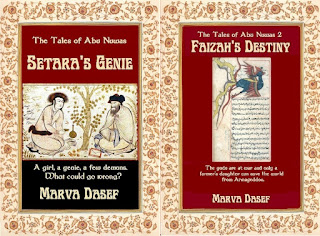
Both books in "The Tales of Abu Nuwas" collection are now available in large print. I'm going to figure out a way to make them bargains despite the required minimum price. Authors who publish their own work on Amazon know what I mean.

The Tales of Abu Nuwas: Setara's Genie: Large Print Edition

Abu Nuwas sits in the bazaar on his threadbare rug; a cup and sign proclaim him a teller of tales. For one small coin, he bids passers by to listen. A poor girl, Najda, sells spices from a tray. Would he, she asks, trade a tale for a packet of spice? Abu Nuwas agrees and begins the epic adventures of a girl and her genie.

As did Scheherazade before him, Abu leaves Najda hanging in the middle of each yarn to keep her coming back. Between stories, he questions the girl about her life. He discovers that she’s been promised in marriage to an old man whom she hates, but she must wed him to save her sick mother’s life. The rich bridegroom will pay for the doctors the mother needs. Meanwhile, Najda sells spices in the market to earn enough money to keep her mother alive.

Faizah's Destiny: The Tales of Abu Nuwas 2: Large Print Edition

The gods are at war and only a farmer’s daughter can save the world from Armageddon.

The village magician has gone missing. His four pupils think he has left a clue to his whereabouts in the Magicalis Bestialis--the book of magical creatures. They must seek the help of the elusive Simurgh, the mythical birds who know all the secrets of the universe.

However, this is not an easy camping trip into the mountains. Spirits, gods, and demons confront the four friends, who are not aware they’re being set up by otherworldly forces for a much larger task.

A farmer’s daughter, Faizah is chosen to lead the humans in the battle. She must persuade a slave, an orphan, and a rich merchant’s son to join in the battle on the side of good. Although divided by Dev, the evil god of war, the teens must band together to find the Simurgh, rescue their teacher, and stave off Armageddon.

Sunday, March 20, 2022

Spring Goddess - Anahita

FAIZAH'S DESTINY: The Tales of Abu Nuwas 2 borrows heavily from Persian mythology, but the gods pretty much match up to the Roman and Greek gods. Essentially, every civilization re-uses the same gods, but give them different names and their own special flavor.

The heroes are often the mighty warrior types: Hercules, Gilgamesh, Samson. Since I’ve written this book for kids, my heroes are teenagers, not at all like the legends (but they might become legendary themselves). They’re not in already in the mythology, so you’ll just have to read "Faizah's Destiny" to find out about them.

Since Easter is all about rebirth - the flowers are blooming, the sheep are lambing, the leaves are .... uh, leaving? Anyway, all cultures appear to have a goddess of Spring. Anahita is very apropos to the reason for the season - sex and birth. Even the Christian god, Jesus, was reborn by rising from the dead.

Anahita

The ancient Persian water goddess, fertility goddess, and patroness of women, as well as a goddess of war. Her name means "the immaculate one". She is portrayed as a virgin, dressed in a golden cloak, and wearing a diamond tiara (sometimes also carrying a water pitcher).
Anahita was very popular and is one of the forms of the 'Great Goddess' which appears in many ancient eastern religions (such as the Syrian/Phoenician goddess Anath). She is associated with rivers and lakes, as the waters of birth. Anahita is sometimes regarded as the consort of Mithra. The dove and the peacock are her sacred animals. I made Anahita my main character’s supporter. She appears to Faizah hovering over a lake. She tells the girl that one or more of her companions (three boys, wouldn’t you know) will be seduced to the dark side by demons. In typical godly fashion, she can’t give Faizah a straight story; she only hints at what might happen.

Excerpt:

Each time the light dimmed, it returned brighter than before, pulsing in time to the beat of her heart. As the shape within the light grew more and more distinct, a part of Faizah’s mind wondered if she should be afraid. Somehow she wasn’t. Instead, she felt a strong attraction to that glowing figure and walked to the lake’s edge to get a better look.

The apparition hovered a few inches above the surface of the lake. Faizah could now see, through the shimmering aura surrounding her, the figure was that of a woman. She was looking out over the lake to the point where the shooting star had disappeared over the caldera rim. Clad in a golden cloak, a diamond tiara adorned her brow, and two small lions lay at her feet. The figure turned slowly to look directly at Faizah, and a gentle smile curved her lips.

Faizah gasped in sudden recognition. This was the goddess Anahita! She did exist! Faizah stood entranced as the patroness of all women, the goddess of water and fertility, and of war, came gliding smoothly over the surface of the lake toward her.

As the figure halted before her, Faizah glanced quickly over her shoulder at their campsite. The boys hadn’t moved, and she could hear Menog’s rumbling snore. She turned back to face the goddess.

“They will not awaken, Faizah,” Anahita’s lilting voice sounded in her ear. “I would speak to you alone.”

“Why...what...why have you appeared to me, Goddess?” Faizah stammered, her voice trembling.
“My husband has listened to your thoughts, Faizah. Ahura favors your purpose. He sent Menog to guide you through the cavern.”

Faizah’s eyes widened as she struggled to grasp what she was hearing. Ahura, too?

“Ah...we are grateful to Ahura for his favor. But...but, if he is protecting us, why did the boys become ill? Why didn’t I get sick, too?”

Anahita’s musical laugh was the tinkling of bells in a breeze. “Pazuzu of the southwest wind controls this valley. He guards it jealously and blows illness toward all who enter. This is why no one lives here.” Her smile widened. “And I might have had some small part in keeping you from getting sick.”

“I have read that Pazuzu can kill,” Faizah ventured, “yet the boys only have a cough. Did you do that, too?”

“No. That was your doing. Pazuzu can indeed kill. The medicine you made is what saved the boys. There is magic in you, Faizah, which is stronger than you know.” Anahita looked over Faizah’s shoulder at their little camp then back at Faizah. Her smile vanished, and her face became serious.

“I, too, favor your journey. But your friends,” she continued with a gesture toward the sleeping boys, “have lost their purpose. Be always on your guard, Faizah, for powerful forces oppose you.”

“If you favor our journey, Goddess, can you not tell me where to find Master Wafai?”

“A fair question, but the answer, I’m sorry to say, is no, I cannot.”

“But...but, you’re a goddess! Surely?”

“Master Wafai is safe; you needn’t worry about him. You are destined to follow a different path.”
Faizah’s brow wrinkled with concern. Why would she be selected by Anahita? She stammered, “What path?”

Anahita’s gaze lowered. “Many no longer believe in us, the gods and goddesses. As their belief wanes, so does our influence in the world. I, my husband, Ahura, my brother and sister goddesses, none of us are as strong as we once were. There are those, like your Master Wafai, who serve us still, and so we retain some of our strength. Even you doubted our existence, but your hope that we were real allows me to appear to you.”

“I’m sorry I ever doubted, Goddess,” Faizah whispered. “What must I do? Is it right that we go first to find the Simurgh, or should we be doing something else?”

“So many questions!” Anahita’s musical laugh drifted across the water. In the distance, a peacock’s raucous shriek seemed to answer her. “Listen, my pet calls to me,” she said. Then her smile faded, and her eyes mirrored the seriousness in her voice.

“Know this, Faizah. I will protect you as much as I can and lend you what assistance I am able. Even so, your success or failure depends on you. Your own wits and your own strength are far more important than any aid I may give you.”

Faizah trembled at the thought that a goddess would depend on her for anything. “Who opposes us?”

“Dev, for one. He relishes the darkness. Darkness begets ignorance, and ignorance begets folly.”

“Dev?” A cold chill ran down Faizah’s back. “The god of war? He is against us? Master Wafai said Dev plots the final war that will destroy the world!”

“This is true. Now you see why it is so important that you succeed in your task.”

Faizah took a deep breath. This was serious. “What else can you tell me? Will we have to face Dev? We’re not heroes. We’re kids. How can we fight a god?” Faizah chewed her lower lip with anxiety.

“I doubt Dev will oppose you directly; he would think that beneath him. Instead, he will send his minions to do his bidding. You must be ever watchful, Faizah, for you cannot know what form they will take. It could be an animal, a human, even a demon sent to turn your friends away from you.”

Anahita’s words did nothing to ease Faizah’s mind. A demon! What could they do against a demon?

*

Faizah's Destiny: The Tales of Abu Nuwas 2
The gods are at war and only a farmer’s daughter can save the world from Armageddon.

 In print and ebook at Amazon. 
 In all ebook formats at Smashwords. Currently discounted to $0.99

The village magician has gone missing. His four pupils think he has left a clue to his whereabouts in the Magicalis Bestialis--the book of magical creatures. They must seek the help of the elusive Simurgh, the mythical birds who know all the secrets of the universe.

However, this is not an easy camping trip into the mountains. Spirits, gods, and demons confront the four friends, who are not aware they’re being set up by otherworldly forces for a much larger task.

A farmer’s daughter, Faizah is chosen to lead the humans in the battle. She must persuade a slave, an orphan, and a rich merchant’s son to join in the battle on the side of good. Although divided by Dev, the evil god of war, the teens must band together to find the Simurgh, rescue their teacher, and stave off Armageddon.

Setara's Genie: The Tales of Abu Nuwas 1

A girl, a genie, a few demons. Would could go wrong?
Print and ebook at Amazon 
In all ebook formats at Smashwords on sales for 99 cents.

This first book featuring Setara doesn't have any Springtime goddesses, but it does have a genie, a flying horse, a dragon, merfolk, and cave demons. 

Thursday, April 01, 2021

Spring Goddesses

FAIZAH'S DESTINY: The Tales of Abu Nuwas 2 borrows heavily from Persian mythology, but the gods pretty much match up to the Roman and Greek gods. Essentially, every civilization re-uses the same gods, but give them different names and their own special flavor.

The heroes are often the mighty warrior types: Hercules, Gilgamesh, Samson. Since I’ve written this book for kids, my heroes are teenagers, not at all like the legends (but they might become legendary themselves). They’re not in already in the mythology, so you’ll just have to read "Faizah's Destiny" to find out about them.

Since Easter is all about rebirth - the flowers are blooming, the sheep are lambing, the leaves are .... uh, leaving? Anyway, all cultures appear to have a goddess of Spring. Anahita is very apropos to the reason for the season - sex and birth. Even the Christian god, Jesus, was reborn by rising from the dead.

Anahita

The ancient Persian water goddess, fertility goddess, and patroness of women, as well as a goddess of war. Her name means "the immaculate one". She is portrayed as a virgin, dressed in a golden cloak, and wearing a diamond tiara (sometimes also carrying a water pitcher).
Anahita was very popular and is one of the forms of the 'Great Goddess' which appears in many ancient eastern religions (such as the Syrian/Phoenician goddess Anath). She is associated with rivers and lakes, as the waters of birth. Anahita is sometimes regarded as the consort of Mithra. The dove and the peacock are her sacred animals. I made Anahita my main character’s supporter. She appears to Faizah hovering over a lake. She tells the girl that one or more of her companions (three boys, wouldn’t you know) will be seduced to the dark side by demons. In typical godly fashion, she can’t give Faizah a straight story; she only hints at what might happen.

Excerpt:

Each time the light dimmed, it returned brighter than before, pulsing in time to the beat of her heart. As the shape within the light grew more and more distinct, a part of Faizah’s mind wondered if she should be afraid. Somehow she wasn’t. Instead, she felt a strong attraction to that glowing figure and walked to the lake’s edge to get a better look.

The apparition hovered a few inches above the surface of the lake. Faizah could now see, through the shimmering aura surrounding her, the figure was that of a woman. She was looking out over the lake to the point where the shooting star had disappeared over the caldera rim. Clad in a golden cloak, a diamond tiara adorned her brow, and two small lions lay at her feet. The figure turned slowly to look directly at Faizah, and a gentle smile curved her lips.

Faizah gasped in sudden recognition. This was the goddess Anahita! She did exist! Faizah stood entranced as the patroness of all women, the goddess of water and fertility, and of war, came gliding smoothly over the surface of the lake toward her.

As the figure halted before her, Faizah glanced quickly over her shoulder at their campsite. The boys hadn’t moved, and she could hear Menog’s rumbling snore. She turned back to face the goddess.

“They will not awaken, Faizah,” Anahita’s lilting voice sounded in her ear. “I would speak to you alone.”

“Why...what...why have you appeared to me, Goddess?” Faizah stammered, her voice trembling.
“My husband has listened to your thoughts, Faizah. Ahura favors your purpose. He sent Menog to guide you through the cavern.”

Faizah’s eyes widened as she struggled to grasp what she was hearing. Ahura, too?

“Ah...we are grateful to Ahura for his favor. But...but, if he is protecting us, why did the boys become ill? Why didn’t I get sick, too?”

Anahita’s musical laugh was the tinkling of bells in a breeze. “Pazuzu of the southwest wind controls this valley. He guards it jealously and blows illness toward all who enter. This is why no one lives here.” Her smile widened. “And I might have had some small part in keeping you from getting sick.”

“I have read that Pazuzu can kill,” Faizah ventured, “yet the boys only have a cough. Did you do that, too?”

“No. That was your doing. Pazuzu can indeed kill. The medicine you made is what saved the boys. There is magic in you, Faizah, which is stronger than you know.” Anahita looked over Faizah’s shoulder at their little camp then back at Faizah. Her smile vanished, and her face became serious.

“I, too, favor your journey. But your friends,” she continued with a gesture toward the sleeping boys, “have lost their purpose. Be always on your guard, Faizah, for powerful forces oppose you.”

“If you favor our journey, Goddess, can you not tell me where to find Master Wafai?”

“A fair question, but the answer, I’m sorry to say, is no, I cannot.”

“But...but, you’re a goddess! Surely?”

“Master Wafai is safe; you needn’t worry about him. You are destined to follow a different path.”
Faizah’s brow wrinkled with concern. Why would she be selected by Anahita? She stammered, “What path?”

Anahita’s gaze lowered. “Many no longer believe in us, the gods and goddesses. As their belief wanes, so does our influence in the world. I, my husband, Ahura, my brother and sister goddesses, none of us are as strong as we once were. There are those, like your Master Wafai, who serve us still, and so we retain some of our strength. Even you doubted our existence, but your hope that we were real allows me to appear to you.”

“I’m sorry I ever doubted, Goddess,” Faizah whispered. “What must I do? Is it right that we go first to find the Simurgh, or should we be doing something else?”

“So many questions!” Anahita’s musical laugh drifted across the water. In the distance, a peacock’s raucous shriek seemed to answer her. “Listen, my pet calls to me,” she said. Then her smile faded, and her eyes mirrored the seriousness in her voice.

“Know this, Faizah. I will protect you as much as I can and lend you what assistance I am able. Even so, your success or failure depends on you. Your own wits and your own strength are far more important than any aid I may give you.”

Faizah trembled at the thought that a goddess would depend on her for anything. “Who opposes us?”

“Dev, for one. He relishes the darkness. Darkness begets ignorance, and ignorance begets folly.”

“Dev?” A cold chill ran down Faizah’s back. “The god of war? He is against us? Master Wafai said Dev plots the final war that will destroy the world!”

“This is true. Now you see why it is so important that you succeed in your task.”

Faizah took a deep breath. This was serious. “What else can you tell me? Will we have to face Dev? We’re not heroes. We’re kids. How can we fight a god?” Faizah chewed her lower lip with anxiety.

“I doubt Dev will oppose you directly; he would think that beneath him. Instead, he will send his minions to do his bidding. You must be ever watchful, Faizah, for you cannot know what form they will take. It could be an animal, a human, even a demon sent to turn your friends away from you.”

Anahita’s words did nothing to ease Faizah’s mind. A demon! What could they do against a demon?

*
Faizah's Destiny: The Tales of Abu Nuwas 2
The gods are at war and only a farmer’s daughter can save the world from Armageddon.

 In print and ebook at Amazon. 
 In all ebook formats at Smashwords. Currently discounted to $0.99
* If prices haven't changed yet on Amazon, wait until it does

The village magician has gone missing. His four pupils think he has left a clue to his whereabouts in the Magicalis Bestialis--the book of magical creatures. They must seek the help of the elusive Simurgh, the mythical birds who know all the secrets of the universe.

However, this is not an easy camping trip into the mountains. Spirits, gods, and demons confront the four friends, who are not aware they’re being set up by otherworldly forces for a much larger task.

A farmer’s daughter, Faizah is chosen to lead the humans in the battle. She must persuade a slave, an orphan, and a rich merchant’s son to join in the battle on the side of good. Although divided by Dev, the evil god of war, the teens must band together to find the Simurgh, rescue their teacher, and stave off Armageddon.

Setara's Genie: The Tales of Abu Nuwas 1
A girl, a genie, a few demons. Would could go wrong?
Print and ebook at Amazon 
In all ebook formats at Smashwords on sales for 99 cents.


Tuesday, November 19, 2019

Tales of Abu Nuwas - Setara's Genie now in Audio!

GET YOUR COPY FREE ON AUDIBLE WITH A NEW MEMBERSHIP!

Buy on Amazon with the ebook! Also available on iTunes.


Abu Nuwas sits in the bazaar on his threadbare rug; a cup and sign proclaim him a teller of tales. For one small coin, he bids passers by to listen. A poor girl, Najda, sells spices from a tray. Would he, she asks, trade a tale for a packet of spice? Abu Nuwas agrees and begins the epic adventures of a girl and her genie. As did Scheherazade before him, Abu leaves Najda hanging in the middle of each yarn to keep her coming back. Between stories, he questions the girl about her life. He discovers that she has been promised in marriage to an old man whom she hates, but she must wed him to save her sick mother. The rich bridegroom will pay for the doctors the mother needs.

Meanwhile, Najda sells spices in the market to earn enough money to keep her mother alive. While relating the fantastical accounts, the old man grows to admire the spice girl, and vows to find a way to help her. Listening to the stories of evil genies, demons, flying horses, dragons, viziers, princes, pirates, and nomadic raiders, young Najda finds her salvation with the help of Abu Nuwas, the teller of tales.

Monday, July 23, 2018

The Gods Must Be Crazy

Get both Tales of Abu Nuwas ebooks for only 99 cents each. 
Sale lasts through the end of July. The books are on Amazon and Smashwords.

Okay, I'm an idiot. Nobody wants these books for 99 cents each. However, I've promised they'll be at that low price for the rest of this month. I'm not one to break promises. So, get 'em if you haven't read them before. They're both very entertaining.

The Gods (and I) Must be Crazy

FAIZAH'S DESTINY borrows heavily from Persian mythology, but the gods pretty much match up to the Roman and Greek gods. Essentially, every civilization re-uses the same gods, but give them different names and their own special flavor.

The heroes are often the mighty warrior types: Hercules, Gilgamesh, Samson. Since I’ve written this book for kids, my heroes are teenagers, not at all like the legends (might become legendary themselves). But they’re not in mythology, so you’ll just have to read "Faizah's Destiny" to find out about them.

As usual, the “real” info is from the Encyclopedia Mythica (http://www.pantheon.org).

Ahura Mazdah

In Persian belief, Ahura Mazdah (“Lord Wisdom”) was the supreme god, he who created the heavens and the Earth, and another son of Zurvan. Atar, his son, battled Azhi Dahaka, the great dragon of the sky (note that Azhi shows up in “Setara's Genie”), and bound it in chains on a high mountain. The dragon was, however, destined to escape and destroy a third of mankind at the final reckoning, before it was slain. Ahura Mazdah was the god of prophetic revelation, and bore both Ahriman and Ormazd.

As leader of the Heavenly Host, the Amesha Spentas, he battles Ahriman and his followers to rid the world of evil, darkness and deceit. His symbol is the winged disc.

Anahita

The ancient Persian water goddess, fertility goddess, and patroness of women, as well as a goddess of war. Her name means “the immaculate one”. She is portrayed as a virgin, dressed in a golden cloak, and wearing a diamond tiara (sometimes also carrying a water pitcher). The dove and the peacock are her sacred animals.

Anahita was very popular and is one of the forms of the ?Great Goddess’ which appears in many ancient eastern religions (such as the Syrian/Phoenician goddess Anath). She is associated with rivers and lakes, as the waters of birth. Anahita is sometimes regarded as the consort of Mithra.

Ahurani

Ahurani is a water goddess from ancient Persian mythology. She watches over rainfall as well as standing water. She was invoked for health, healing, prosperity, and growth. She is the daughter of the great god of creation and goodness, Ahura Mazda. Her name means “She who belongs to Ahura.”

Dev

In Persian mythology, Dev is a demon of enormous power, a ruthless and immoral god of war.

The Gods’ Roles in Faizah’s Destiny

I use Ahura more or less as described in the mythology site. Because he was the leader of the Amesha Spentas (the good guys), I decided to portray him like Zeus or Thor, just another god amused at the foibles of humankind, but rarely steps into the action. He is also equated with Mithra, so I have him married to Anahita. Ahura shows up in only one chapter (“Demons and Deities”) and he chats with Anahita about the progress of the heroes. He claims to have set up the whole situation (just like a man).

I made Anahita my main character’s supporter. She appears to Faizah hovering over a lake. She tells the girl that one or more of her companions (three boys, wouldn’t you know) will be seduced to the dark side by demons. In typical godly fashion, she can’t give Faizah a straight story; she only hints at what might happen.

I also include a guest appearance by Ahurani, another goddess associated with water. One of the boys is in need of motherly advice, and Ahurani provides it for him. To say anything else would be a spoiler.

Finally, Dev is the villain of this book. As a god of war, his purpose is to create chaos and disruption. He feeds off anger and strife. He’s just downright mean and Evil is his middle name (if he had one). He’s the god who sends the lesser demons to tempt the boys to his side in the first skirmish of the upcoming battle between good and evil, Armageddon.

Excerpt:

Each time the light dimmed, it returned brighter than before, pulsing in time to the beat of her heart. As the shape within the light grew more and more distinct, a part of Faizah’s mind wondered if she should be afraid. Somehow she wasn’t. Instead, she felt a strong attraction to that glowing figure and walked to the lake’s edge to get a better look.

The apparition hovered a few inches above the surface of the lake. Faizah could now see, through the shimmering aura surrounding her, the figure was that of a woman. She was looking out over the lake to the point where the shooting star had disappeared over the caldera rim. Clad in a golden cloak, a diamond tiara adorned her brow, and two small lions lay at her feet. The figure turned slowly to look directly at Faizah, and a gentle smile curved her lips.

Faizah gasped in sudden recognition. This was the goddess Anahita! She did exist! Faizah stood entranced as the patroness of all women, the goddess of water and fertility, and of war, came gliding smoothly over the surface of the lake toward her.

As the figure halted before her, Faizah glanced quickly over her shoulder at their campsite. The boys hadn’t moved, and she could hear Menog’s rumbling snore. She turned back to face the goddess.

“They will not awaken, Faizah,” Anahita’s lilting voice sounded in her ear. “I would speak to you alone.”

“Why...what...why have you appeared to me, Goddess?” Faizah stammered, her voice trembling.

“My husband has listened to your thoughts, Faizah. Ahura favors your purpose. He sent Menog to guide you through the cavern.”

Faizah’s eyes widened as she struggled to grasp what she was hearing. Ahura, too?

“Ah...we are grateful to Ahura for his favor. But...but, if he is protecting us, why did the boys become ill? Why didn’t I get sick, too?”

Anahita’s musical laugh was the tinkling of bells in a breeze. “Pazuzu of the southwest wind controls this valley. He guards it jealously and blows illness toward all who enter. This is why no one lives here.” Her smile widened. “And I might have had some small part in keeping you from getting sick.”

“I have read that Pazuzu can kill,” Faizah ventured, “yet the boys only have a cough. Did you do that, too?”

“No. That was your doing. Pazuzu can indeed kill. The medicine you made is what saved the boys. There is magic in you, Faizah, which is stronger than you know.” Anahita looked over Faizah’s shoulder at their little camp then back at Faizah. Her smile vanished, and her look became serious.

“I, too, favor your journey. But your friends,” she continued with a gesture toward the sleeping boys, “have lost their purpose. Be always on your guard, Faizah, for powerful forces oppose you.”

“If you favor our journey, Goddess, can you not tell me where to find Master Wafai?”

“A fair question, but the answer, I’m sorry to say, is no, I cannot.”

“But...but, you’re a goddess! Surely―”

“Master Wafai is safe; you needn’t worry about him. You are destined to follow a different path.”
Faizah’s brow wrinkled with concern. Why would she be selected by Anahita? She stammered, “What path?”

Anahita’s gaze lowered. “Many no longer believe in us, the gods and goddesses. As their belief wanes, so does our influence in the world. I, my husband, Ahura, my brother and sister goddesses, none of us are as strong as we once were. There are those, like your Master Wafai, who serve us still, and so we retain some of our strength. Even you doubted our existence, but your hope that we were real allows me to appear to you.”

“I’m sorry I ever doubted, Goddess,” Faizah whispered. “What must I do? Is it right that we go first to find the Simurgh, or should we be doing something else?”

“So many questions!” Anahita’s musical laugh drifted across the water. In the distance, a peacock’s raucous shriek seemed to answer her. “Listen, my pet calls to me,” she said. Then her smile faded, and her eyes mirrored the seriousness in her voice.

“Know this, Faizah. I will protect you as much as I can and lend you what assistance I am able. Even so, your success or failure depends on you. Your own wits and your own strength are far more important than any aid I may give you.”

* * *

TALES OF ABU NUWAS 1: SETARA'S GENIE
A girl, a genie, a few demons. What could go wrong?

Abu Nuwas sits in the bazaar telling stories to the passersby he can tempt to pay. He relates the adventures of the bored daughter of a rich merchant, Setara, and her genie, Basit, as they encounter the creatures of legend and folklore: a lonely cave demon seeking a home; a flying, fire-breathing horse who has lost his mate; a dragon searching for his family; an evil genie hunting for the man who bottled him; and a merboy prince cast out of his undersea kingdom.

TALES OF ABU NUWAS 2: FAIZAH'S DESTINY
The gods are at war and only a farmer’s daughter can save the world from Armageddon.

The village magician has gone missing. His students search for him, but are caught up in a war between the forces of light and dark. The magician's best student, Faizah, is chosen by Anahita, the goddess of light, to lead the humans into battle on the side of good. Can a simple farm girl stave off Armageddon?


Saturday, July 21, 2018

What is a Simurgh?

Get both Tales of Abu Nuwas ebooks for only 99 cents each. 
Sale lasts through the end of July. The books are on Amazon and Smashwords.


Okay, I'm an idiot. Nobody wants these books for 99 cents each. However, I've promised they'll be at that low price for the rest of this month. I'm not one to break promises. So, get 'em if you haven't read them before. They're both very entertaining.

On to other business. So, what is a Simurgh? If you don't know, then here's a bit of info on the mysterious bird of legend.

What the Heck is a Simurgh?

An early reader of “Faizah’s Destiny” asked the question. When I wrote the book, I was definitely under the impression that everybody in the world knows what a simurgh is, but I guess I was wrong.

If you’ve read the 1001 Arabian Nights or even saw the movie with John Leguizamo as the genie (brilliant!), you’ll be familiar with the intelligent Big Bird. From the Encyclopedia Mythica, http://pantheon.org), my favorite source for all things mythic:

In Persian legend Simurgh is a gigantic, winged monster in the shape of a bird; a kind of peacock with the head of a dog and the claws of a lion. Its natural habitat is a place with plenty of water. According to legend, the creature is so old that it has seen the world destroyed three times over. In all that time, Simurgh has learned so much that it is thought to possess the knowledge of all ages.

I pretty much stick to the traditional description here except for that dog head and lion claws thing. Considering that the Simurgh know everything (really, not like that annoying guy at work who just thinks he knows everything), then it seemed logical to me and my heroine Faizah to ask them where to find Wafai the missing magician.

The boys in the little band of rescuers scoff at her, but it all works out anyway. The search for the bird does get them into the mountains where they need to be to save the world from Armageddon. You’ll have to admit that is just a teensy bit more important then finding an old magician. It’s all good, though. The magician finds the kids and the birds.

Illustration: This is a real page on the Simurgh from a real Arabic text dating back to circa 900 AD. I don’t see any dog’s head or lion claws. Do you?

Excerpt:

Faizah felt the sunlight on her cheek. Morning. She kept her eyes closed, savoring the warmth until something blocked out the sun. At first she thought it a cloud, and she opened her eyes a slit to check for rain.

A huge bird stood motionless over her, regarding her with a steady, unblinking gaze.

Her eyes flew all the way open. The Simurgh was as tall as Master Wafai, the biggest bird by far that she had ever seen. It looked like a giant peacock, save that its beak did not come to a point. The eyes were different, too. Instead of beady black eyes like a peacock, the Simurgh’s matched the iridescent spots on its tail. It also sported a spray of upright feathers on its head, giving it a jaunty appearance.

Was this the only one, she wondered, or were there more? Turning her head slightly, she saw out of the corner of her eye there were, indeed, more. Four more, in fact. One stood by each sleeping form.

“Hello,” she managed to say and wondered what to do next. Sit up, or remain as she was? Would movement frighten them? This last question was quickly answered by Harib leaping out of his blankets with a startled yelp. Faizah laughed as she sat up―the Simurgh standing over Harib hadn’t even flinched.

The Simurgh beside her spoke. “Good morning, Faizah. Welcome to our home.”

“Thank you,” she responded then struggled to her feet and bowed to the bird. Curtseying wasn’t something she did very often, and she thought it a poor time to start now. “We’ve come a long way to find you. It turns out we didn’t need to after all, but here we are.”

“Yes.” There was humor in the bird’s voice. “You sought our counsel on the whereabouts of Master Wafai.” The bird revealed it had both arms and wings as it gestured with one feathery limb toward the magician.

As well as possessing both arms and wings, Faizah noted the bird’s beak did not prevent it from speaking clearly. Looking closely, she saw the Simurgh’s beak was quite flexible, more like pointed lips than the beak of the birds she was familiar with. This accounted for the bird’s precise speech.

By this time, all of the travelers were up and variously gawking or grinning at the birds that stood before them. Master Wafai drew himself to his full, magisterial height and settled his robes about him before addressing the Simurgh in his most formal tones. Faizah couldn’t help but smile. The fact he was practically vibrating with excitement spoiled the effect a little.

“I have spent my entire life waiting to meet a magical creature such as yourselves.” He waved his arms in circles. “This is most exciting! Most exciting indeed!”

“Had you stopped waiting, Magician,” the Simurgh facing him replied, “and started searching instead, you might have met us sooner. Creatures of magic do not often seek out mortals, but they can be found if you seek them. As close to you as the valley on the other side of these mountains lives a young woman who keeps company with a djinn and a flying horse. You could have met her after only a short journey, had you cared to make it.”

“Setara! Yes, I’ve heard of her.” Wafai’s shoulders slumped. He nodded eyes downcast. “You are right. I sat and waited for the magic to come to me. I should have gone to it.”

The giant bird nodded. “Oh, one other thing. The plural is Simurghs, Master Wafai.”
Wafai’s cheeks reddened above his white beard, and he bowed his head. “I’ll correct that error in my texts.”

“Never mind,” the Simurgh replied, “that doesn’t matter anymore. You are here now, and we will tell you your fate if you wish it.”

“How does this work? Do you see the future?”

“We see all the possible futures. You move from one future to another, depending on what you do in the now.”

“Do you mean that what you tell us may not happen?”

We will tell you the future that lies ahead of you on the path you now travel. If you choose a different path, you will have a different future.” The Simurgh standing before Wafai nodded, indicating the other birds. “We will also tell you of a few things to avoid.”

* * *

FAIZAH'S DESTINY
The gods are at war and only a farmer’s daughter can save the world from Armageddon.

The village magician has gone missing. His four pupils think he has left a clue to his whereabouts in the Magicalis Bestialis--the book of magical creatures. They must seek the help of the elusive Simurgh, the mythical birds who know all the secrets of the universe.

However, this is not an easy camping trip into the mountains. Spirits, gods, and demons confront the four friends, who are not aware they’re being set up by otherworldly forces for a much larger task.

A farmer’s daughter, Faizah is chosen to lead the humans in the battle. She must persuade a slave, an orphan, and a rich merchant’s son to join in the battle on the side of good. Although divided by Dev, the evil god of war, the teens must band together to find the Simurgh, rescue their teacher, and stave off Armageddon.


Friday, February 23, 2018

PDT: Pacific Demon Time

IT'S DEMON TIME!

Setara and her genie, Basit, meet many interesting mythological creatures, but only two should be included in the category Monsters. Here’s a bit about the role each monster plays in Setara’s Genie.

Azi (or Azhi) Dahaka

Aži Dahaka is the source of the modern Persian word azhdaha or ezhdeha (Middle Persian Azdahag) meaning "dragon", often used of a dragon depicted upon a banner of war.

Azhi Dahaka was created by Angra Mainu (the son of Angra Mainu and Autak), or the Ultimate Evil, to oppose goodness and truth (Allan, et al., 1999). Literally made of the unclean khrafstra, animals such as snakes, toads, scorpions, frogs and lizards, this dragon embodied corruption.

In the Avesta, the Azhi Dahaka is described as a three-headed, six-eyed, dragon-like monster. He is said to have a thousand senses, and to bleed snakes, scorpions, and other venomous creatures. He also is said to bring or control storms and disease. His wings were said to be so enormous that they would block out the sun.

In the Shahnameh written around 1000 AD, Azhi Dahaka was semi-anthropomorphosized as Zahak or Zohak, though many of the older characteristics were retained in the new version.

Even though this particular description includes multiple heads and pretty bad attitude, I also found an ancient bas relief that purports to be Azhi Dahaka. Decide what you will. A monster is a monster no matter how many heads he or she has.

Excerpt Featuring Azhi Dahaka

Setara rounded the bend in the tunnel and stopped dead in her tracks. Azizah and Kairav stood at one end of a huge cavern, heaving large stones as fast as they could. At the other end, about forty feet away, the strangest creature she’d ever seen was shooting jets of fire from its mouth. It had great bat-like wings that created a rush of wind each time the dragon stroked downward. It possessed four legs but had reared up and clawed at the air with the front set. Fangs at least six inches long lined the animal’s jaws. It seemed reptilian with its elongated head and scaly sides. However, it was huge by reptile standards, being more than twenty feet long and barely fit in the end of the cavern. Its scales rippled with colors—green, violet, orange, blue.

Basit flew around the cavern, attempting to outflank the creature. He began hurling balls of light from his fingertips. They didn’t appear to do anything other than annoy the beast, but the interruption did distract it from breathing fire at Azizah and Kairav. When it turned its head to shoot fire toward Basit, Azizah ran forward and threw another huge rock. It struck the beast’s head, knocking it against the wall.

It turned one last time and let out a loud roar that shook small stones off the walls. Then, it shrank rapidly to no more than ten feet long. With a single bound, it leaped into the tunnel on the far side of the cavern and was gone in a flash of purple and green.

Setara ran to Azizah, who dropped the stone she was just about to throw. Kairav and Basit joined them. Sheik ran in circles around the group, barking for all he was worth.

“Shush, Sheik. We can’t hear ourselves think.” Setara chastised the agitated dog. Sheik dropped to his belly panting from the excitement.

“What was that thing?” Setara looked at the grim faces of her friends.

“Azhi Dahaka,” Basit answered.
* * *

TALES OF ABU NUWAS 1 - SETARA'S GENIE 
A girl, a genie, a few demons. Would could go wrong?

Amazon Kindle on sale for only $0.99
Smashwords all formats on sale for $0.99

Abu Nuwas sits in the bazaar telling stories to the passersby he can tempt to pay. He relates the adventures of the bored daughter of a rich merchant, Setara, and her genie, Basit, as they encounter the creatures of legend and folklore: a lonely cave demon seeking a home; a flying, fire-breathing horse who has lost his mate; a dragon searching for his family; an evil genie hunting for the man who bottled him; and a merboy prince cast out of his undersea kingdom.

Monday, June 26, 2017

Double Feature - On Sale for 99¢

Both TALES OF ABU NUWAS books are on sale for the rest of this month (or longer) for only 99¢ each.

TALES OF ABU NUWAS: SETARA'S GENIE
A girl, a genie, a few demons. What could go wrong?

Abu Nuwas sits in the bazaar on his threadbare rug; a cup and sign proclaim him a teller of tales. For one small coin, he bids passers by to listen. A poor girl, Najda, sells spices from a tray. Would he, she asks, trade a tale for a packet of spice? Abu Nuwas agrees and begins the epic adventures of a girl and her genie.

As did Scheherazade before him, Abu leaves Najda hanging in the middle of each yarn to keep her coming back. Between stories, he questions the girl about her life. He discovers that she’s been promised in marriage to an old man whom she hates, but she must wed him to save her sick mother’s life. The rich bridegroom will pay for the doctors the mother needs. Meanwhile, Najda sells spices in the market to earn enough money to keep her mother alive.

He relates the adventures of the bored daughter of a rich merchant, Setara, and her genie, Basit, as they encounter the creatures of legend and folklore: a lonely cave demon seeking a home; a flying, fire-breathing horse who has lost his mate; a dragon searching for his family; an evil genie hunting for the man who put him in a lamp; and a merboy prince cast out of his undersea kingdom.

TALES OF ABU NUWAS 2: FAIZAH'S DESTINY
The gods are at war and only a farmer’s daughter can save the world from Armageddon.

The village magician has gone missing. His four pupils think he has left a clue to his whereabouts in the Magicalis Bestialis--the book of magical creatures. They must seek the help of the elusive Simurgh, the mythical birds who know all the secrets of the universe.

However, this is not an easy camping trip into the mountains. Spirits, gods, and demons confront the four friends, who are not aware they’re being set up by otherworldly forces for a much larger task.

A farmer’s daughter, Faizah is chosen to lead the humans in the battle. She must persuade a slave, an orphan, and a rich merchant’s son to join in the battle on the side of good. Although divided by Dev, the evil god of war, the teens must band together to find the Simurgh, rescue their teacher, and stave off Armageddon.

Sunday, June 25, 2017

Demonic Creatures in Mythology

IT'S DEMON TIME!

Setara and her genie, Basit, meet many interesting mythological creatures, but only two should be included in the category Monsters. Here’s a bit about the role each monster plays in Setara’s Genie. For the rest of June: 99 Cents on Kindle or on Smashwords in multiple formats.

Azi (or Azhi) Dahaka

Azhi is a dragon demon who’s supposed to be dead, but comes back to life a little bit ticked off because his blood was used by the Great Vizier hundreds of years before to create a breed of fire-breathing, flying horses.

From the Encyclopedia Mythica (http://www.pantheon.org/articles/a/azi_dahaka.html)
A storm demon from Iranian mythology. He steals cattle and brings harm to humans. It is a snake-like monster with three heads and six eyes who also personifies the Babylonian oppression of Iran. The monster will be captured by the warrior god Thraetaona and placed on the mountain top Dermawend. In a final revival of evil, it will escape its prison, but at the end of time (fraso-kereti) it will die in the river of fire Ayohsust.
Even though this particular description includes multiple heads and pretty bad attitude, I also found an ancient bas relief that purports to be Azhi Dahaka. Decide what you will. A monster is a monster no matter how many heads he or she has.
Excerpt From Setara's Genie Featuring Azhi Dahaka

Setara rounded the bend in the tunnel and stopped dead in her tracks. Azizah and Kairav stood at one end of a huge cavern, heaving large stones as fast as they could. At the other end, about forty feet away, the strangest creature she’d ever seen was shooting jets of fire from its mouth. It had great bat-like wings that created a rush of wind each time the dragon stroked downward. It possessed four legs but had reared up and clawed at the air with the front set. Fangs at least six inches long lined the animal’s jaws. It seemed reptilian with its elongated head and scaly sides. However, it was huge by reptile standards, being more than twenty feet long and barely fit in the end of the cavern. Its scales rippled with colors—green, violet, orange, blue.

Basit flew around the cavern, attempting to outflank the creature. He began hurling balls of light from his fingertips. They didn’t appear to do anything other than annoy the beast, but the interruption did distract it from breathing fire at Azizah and Kairav. When it turned its head to shoot fire toward Basit, Azizah ran forward and threw another huge rock. It struck the beast’s head, knocking it against the wall.

It turned one last time and let out a loud roar that shook small stones off the walls. Then, it shrank rapidly to no more than ten feet long. With a single bound, it leaped into the tunnel on the far side of the cavern and was gone in a flash of purple and green.

Setara ran to Azizah, who dropped the stone she was just about to throw. Kairav and Basit joined them. Sheik ran in circles around the group, barking for all he was worth.

“Shush, Sheik. We can’t hear ourselves think.” Setara chastised the agitated dog. Sheik dropped to his belly panting from the excitement.

“What was that thing?” Setara looked at the grim faces of her friends.

“Azhi Dahaka,” Basit answered.
* * *

Tales of Abu Nuwas - Setara's Genie
A Girl, a Genie, a Few Demons...What could go wrong?

Abu Nuwas sits in the bazaar on his threadbare rug; a cup and sign proclaim him a teller of tales. For one small coin, he bids passers by to listen. A poor girl, Najda, sells spices from a tray. Would he, she asks, trade a tale for a packet of spice? Abu Nuwas agrees and begins the epic adventures of a girl and her genie.


As did Scheherazade before him, Abu leaves Najda hanging in the middle of each yarn to keep her coming back. Between stories, he questions the girl about her life. He discovers that she’s been promised in marriage to an old man whom she hates, but she must wed him to save her sick mother’s life. The rich bridegroom will pay for the doctors the mother needs. Meanwhile, Najda sells spices in the market to earn enough money to keep her mother alive.

He relates the adventures of the bored daughter of a rich merchant, Setara, and her genie, Basit, as they encounter the creatures of legend and folklore: a lonely cave demon seeking a home; a flying, fire-breathing horse who has lost his mate; a dragon searching for his family; an evil genie hunting for the man who put him in a lamp; and a merboy prince cast out of his undersea kingdom.

Friday, June 23, 2017

Fantasy Book Companions - The Boys Have Their Say

TALES OF ABU NUWAS 2: FAIZAH'S DESTINY

The Boys Have Their Say

(Marva Dasef) I am the author of “Faizah’s Destiny” and decided the three boys in the story might like to share their views while Faizah isn’t in the room.

I’m pleased to have Faizah’s three male companions here today for the interview. How are you doing?

(Parvaiz) Sure, make us out as secondary characters. Typical. Snorts in disgust.

(Marva) A little testy aren’t you? After all, the book is titled “Faizah’s Destiny” not “Parvaiz’s Destiny.”


(Harib) Sorry about Parvaiz, ma’am. He’s a little touchy since he was a slave all his life. He’ll loosen up the longer he’s free.

(Parvaiz) Easy for you, Harib. Your father is the richest man in the territory. He owns slaves!

(Bahaar) Hey, Parvaiz, lighten up. Harib or his father weren’t ever mean to slaves. His dad has even freed most of his workers, and they chose to stay on.

(Parvaiz) mumble...

(Marva) Hey, sorry to hit a sore spot Parvaiz. Maybe if you talked it out a little. Don’t you feel a little grateful to your father for adopting you as his son and heir?

(Harib) What’s that, Parvaiz? I don’t hearrrr youuuu!

(Parvaiz) Yeah, yeah. I am grateful to Ahmadj, but at my age it’s a little hard to adapt to having a father.

(Bahaar) I wish I had even a fake father to get used to. Me and my brother are all on our own. We don’t carry a chip around on our shoulder.

(Parvaiz) All right! I’m grateful! Now can we just drop it?

(Marva) Of course. Tell the readers about your search for Master Wafai.

(Harib) Jabs his hand in the air. Oh, me, me!

(Marva) Go ahead, Harib.

(Harib) One day, we all went to school in the morning at Master Wafai’s house. But he was gone and the room was a mess! We couldn’t think of anything other than he was kidnapped.

(Bahaar) You see, his herb bag was still there. He wouldn’t go anywhere to treat anybody without that. It had to be a kidnapping.

(Parvaiz) But Faizah doesn’t accept that story. Well, she didn’t say Wafai wasn’t kidnapped, but she thought he left a sign we were supposed to find the Simurghs to find out where he was.

(Marva) Why did she think that?

(Harib) His book of magical beasts was open to the page about the Simurghs and a big X was chalked on the page. She figured he’d never mark up a book except for good reason.

(Marva) So you all set out to search for the Simurgh?

(Parvaiz) No way! I thought it was an idiot idea. Faizah being a girl and all...

(Bahaar) interrupting Hey! Faizah can take care of herself. She made that pretty clear when she caught up to us.

(Harib) Yeah. She never hid behind her skirts or us. She always jumped in and started swinging. Remember when Raziq and his gang were beating you up?

(Bahaar) Huffs I could of taken them. But it was nice you and Faizah showing up to help.

(Marva) So, you’re saying at first that you all didn’t want Faizah to go along on the search, but you changed your mind.

(Parvaiz) Well, yeah. I didn’t know her like these guys. She pulled her weight once we got going. She even saved the rest of us from Pazuzu’s ill wind.

(Marva) Ill wind?

(Parvaiz) Yeah, it’s a demon who makes everybody sick. Most of the time, people die, but Faizah knew what plants to use to cure us.

(Marva) Speaking of demons, what was that all about?

Bahaar and Parvaiz turn noticeably red.

(Harib) That jerk demon didn’t take me over like these two.

(Bahaar) We apologized for that! It wasn’t our fault.

(Parvaiz) Right. Harib didn’t even have a very good demon try to tempt him to Dev’s side.

(Marva) Who’s this Dev?

(Parvaiz) God of war. What could we do? Both Bahaar and I wanted to be warriors, and the demons promised we would be great heroes.

(Harib) Yeah. All Nanghaithya did was try to make me feel bad. Not a good way to convince somebody to join the dark side.

(Marva) I know there’s plenty more to tell the readers about your search for Wafai, the battle with the demons, and so forth. But since I’d like to sell a few books, we’ll leave it for now and let folks read about it themselves.

Thank you, boys. You’ve been a great interview.

(Boys) Sure. Anytime. Hey, how about a story starring me?

(Marva) Well, we'll see what the future brings. How about an excerpt from Faizah's Destiny for now?

Excerpt:

She looked at Harib when he said, “Ahmajd is a good man, but he’s hardly the type to run off after mountain raiders. Matter of fact, I can’t think of anyone in the whole village who’d even consider it. You heard Faluj. He didn’t even suggest forming a search party. I don’t think anybody is going to do anything.”

Faizah bit her lip in frustration. The villagers lacked any adventurous spirit. Most preferred to live their lives as quietly and safely as they could.

Leaning over the table, Parvaiz stared thoughtfully at the open page of the book. “I haven’t had the chance to get to know Master Wafai, or anybody else yet, but I have a feeling Faizah is on the right track. Still, I think he just meant for us to search for him in the mountains, not go looking for these birds.”

Bahaar stood looking down at his feet, lost in thought. Now he lifted his head to look at Parvaiz for a second and then turned to Harib. “How about you, Harib? What do you think?”

Harib sighed and scratched his head. “I agree with Parvaiz. But we can’t go charging into the raider’s camp and tell them to give him back. They’d just laugh at us...or worse.”

Parvaiz nodded. “However, we can at least try to track where he is. If we find some evidence, we can come back to tell the village elders.”

“All right. I’ll concede Master Wafai was just directing us to the mountains, but we still need to figure out how to get started,” Faizah said. “Once we convince our parents,” she continued, glancing at Bahaar, “or brother, to let us go, we can work out the rest ourselves.”

Parvaiz stared at her and then gave a short bark of a laugh. “What makes you think you’re going? This is going to be hard enough without having a girl tagging along. That’s the last thing we need!”

Faizah glared at Parvaiz, her face flushed with anger. “I can take care of myself! Nobody has to watch out for me. Least of all some slave boy,” she shouted at Parvaiz. She regretted the last comment the moment she said it. Still, it didn’t make her any less angry that these boys, she thought were her friends, would so casually dismiss her just because she was a girl.

“You have no call?” Parvaiz began and then shut his mouth. He looked at Harib and Bahaar, who were both studying their feet with intense interest.

Bahaar looked up at him and then over at Faizah and shrugged. “Sorry Faizah, I have to agree with Parvaiz. I...I just don’t want you to get hurt.”

Faizah turned to Harib. “Well? Do you agree?”

The boy’s face reddened, and he wouldn’t meet her eyes. “I’m sorry,” he whispered.

She glared at each of them in turn, spun on her heel, and stormed out of the house, her fists clenched and her head high. Stiff-backed, she marched across the tiny courtyard and through the archway. Only when hidden by the wall, did her shoulders slump and the tears begin to flow.

* * *

FAIZAH'S DESTINY
The gods are at war and only a farmer’s daughter can save the world from Armageddon.
The village magician has gone missing. His four pupils think he has left a clue to his whereabouts in the Magicalis Bestialis--the book of magical creatures. They must seek the help of the elusive Simurgh, the mythical birds who know all the secrets of the universe.

However, this is not an easy camping trip into the mountains. Spirits, gods, and demons confront the four friends, who are not aware they’re being set up by otherworldly forces for a much larger task.

A farmer’s daughter, Faizah is chosen to lead the humans in the battle. She must persuade a slave, an orphan, and a rich merchant’s son to join in the battle on the side of good. Although divided by Dev, the evil god of war, the teens must band together to find the Simurgh, rescue their teacher, and stave off Armageddon.


Saturday, March 04, 2017

It's Been Awhile Since I Posted

I haven't written a blog post in a long time. I got through the Holiday buying promos, then I decided to try again on the 4th (5th if you count Spellslinger) in the Witches of Galdorheim Series. Then, taxes required some attention. Ducks aligned and ready to shoot down with just a wee bit more of real documentation rather than guesswork.

This is a long post, but I hope you'll read it because it brought to light an interesting phenomena: USING HISTORICAL PEOPLE AS CHARACTERS IN FICTION

I wanted to write a new post. No, not a re-run like I've been doing far to much. An opportunity presented itself in the form of an email from a reader. I don't get those often. Here's what she said:
Dear Marva:
I am so glad to have tracked your email down.   I have come across your ‘Tales of Abu Nuwas’ and I am so intrigued by them.  I was doing a bit of research on Abu Nuwas as I am going to Zanzibar shortly and I am looking at traditional stories that have been popular there.  I just wondered what your source for the stories are, are they based on the traditional tales?  I am particularly interested in the relationship between the story teller and Najda and the way he realised she was preoccupied about her forthcoming forced marriage to the much older man and wondered if that was your own creation or based on one of the original Abu Nuwas stories.
I look forward to hearing from you.
I was a bit bemused how this book had anything to do with a trip to Zanzibar. But, hey, I'm happy to heard from any and all readers. So, I wrote back.
Thanks for writing. Setara's Genie is one of my favorites.
I "discovered" Abu Nuwas when I was combing the disparate stories of Setara's adventures. Since Scheherazade was always in the back of my mind, I decided to have a story teller who served the same purpose. Frame stories interest me. When I found information on Abu Nuwas, I hoped he wouldn't be mad if I appropriated his persona. The real Abu Nuwas wrote poems which would not be kid-friendly. The old picture I found of him (which is on the book's cover now) was perfect for the character I wanted.
So, Abu Nuwas the real man and my version haven't much in common except name and the fact they were story tellers. I also made up Najda. After all, what's a story teller without an audience. I wanted the frame story to be as interesting as the other tales. I'm glad you appreciated that part of the story.
For the stories themselves, I did borrow a lot from middle-eastern mythology including demon names like Azhi Dahaka. I actually selected new names for most of the characters from made-up names to real Arabic or Persian names.  
Then, the reader replied:
Thanks so much Marva - so kind of you to reply. 
I think the Abu Nuwas stories I am looking for are different. I can't  quite work it out but as far as I can gather there is the writer/poet you mention and then a series of stories about the trickster Abu Nuwas and these are Swahili tales and I think (?) there is no link or am I wrong ?
Here are translations of the Swahili tales in English and this was published in Tanzania but interestingly an English re teller - daughter of the man who wrote them down from the Swahili in the 1930s (apparently someone else called Steere wrote them down in the 19th century)
http://www.africanbookscollective.com/books/tales-of-abunuwas-and-other-stories
"Tales of Abunuwas and Other Stories are translations of Hadithi za Abunuwasi na Hadithi Nyingine, from Swahili into English by John Lewis-Barned and retold here by his daughter Suzi Lewis-Barned. The stories were first published in 1935. Whilst the Abunuwasi tales are available in English translations from the Arabic originals, these translations into English from an early Swahili edition add a new and interesting dimension to them"
I would be grateful for any light you can shed on this and thanks so much for your wonderful stories. 
I checked the link to the book translated from Swahili. I discovered that the famed bawdy poet I used as my story teller, was also somehow the main character of a group of folktales adapted in the Swahili tradition. But the character in the Swahili tales are nothing like the real Abu Nuwas. In their stories, he's a scamp and trickster who stars in the stories. At least some of the stories starring Abunuwasi are also featured in "1001 Arabian Nights" so the borrowing included not only a real poet from the 6th C., but a fictional story teller (mine), a trickster character named after the real person, but also a Scheherazade of sorts. I replied to the reader with this theory, various real and fictional characters jumping between real life and folk tales. I love this idea. I really do.
I did not know about the reinterpretation into Swahili.  My stories, while based on Persian and Arabian mythology are my own, not by Abu Nuwas. I did get a lot of inspiration from 1001 Arabian Nights.
I did read translations of Abu's original poems. They were somewhat risque--an ode to wine and the joys of pederasty. I didn't realize some of his poetry might have shown up in the 1001 Arabian Nights. I did know that the stories in 1001 come from many traditions. There is no single 1001 Arabian Nights book. It's fascinating how folk tales cross between cultures. A good story is a good story no matter the language.
Interestingly, it appears the Swahili story teller is also a borrowed version of the original Abu Nuwas. I think possibly Abu is the source for more than one tradition. Like Scheherazade, Abu Nuwas is credited for more stories than he actually wrote.
https://www.britannica.com/biography/Abu-Nuwas
Thanks for the link. Sorry that my Abu Nuwas is not the trickster of the Swahili tradition. They both were based on the same real poet it appears. I'm going to look into this in more detail. I love research.
And this is why Lin-Manuel Miranda can legitimately have the founding fathers in "Hamilton" speak in rap.